All about Tubes, Tube Circuits, Tube Gear
Showing posts with label Kenwood JL-545. Show all posts

Wednesday, June 13, 2012

Kenwood JL-545 (3): Midrange Shuffle

 "Inductor" helpfully posted this:

Relating to the Mid.
MAX PR0411M8
Looks like a serious pro product from MAX/MaxSpeakers, Max Fidelity, Max Professional.
Home Page
SOLEN/MAX FIDELITY

with real SPL data (98/99dB), impedance curve not available but could have Fs around 100/150 Hz as from looking at the output graph. So a 300/400 Hz xover point is more than adequate (second order).
It seems to have been superseded by this NEO.
http://www.solen.ca/pdf/max/pr4neo8.pdf


 Thanks for the links.
Yep the midrange is one of Fabian's creations.

I still think it won't really do the whole upper for me,
and needs a tweeter to round it out at the top.

I could still use a good blueprint for a 3rd order,
3-way crossover (8 ohm),
that crosses at 400-800 on the low and 2000-3000 on the high.

I can fine-tune it later with a zobel etc. when I nail down the woofer. Well, I have agreed that the 200 watt midrange is probably an over-match here.

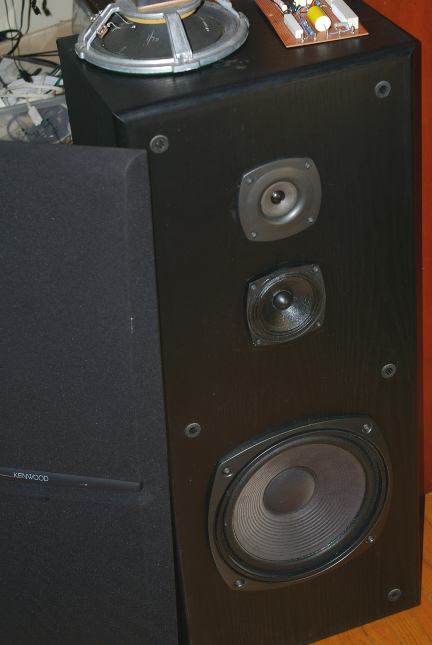
So I cannibalized the Hitachi's for the Tweeter and mid,
and I pulled out the big big mids to use with the free 12" woofers I found in the garage (more later).

The four new drivers cost me about $7 each ($30 for the Hitachi's as-is).

For reference,


here is a comparison of the Hitachi mid and the original Kenwood mid.
You can see the Hitachi is much bigger and better:


Now the Kenwood is near-perfect in balance and sound.
I was actually surprised at the bigness and clarity of the new combination:


Tweeters: Hitachi ferrofluid cooled

Mids: Hitachi semi-closed back midrange

Woofs: Original Kenwood with ceramic cancellation rings.
 
Right now I've just screwed the mid on the front, because its oversize:
I'm going to recut the hole later. I just wanted to hear them.

...

 Well I have no way to quantify the change,
but it sounds much better than it did.
Boominess is gone, lots of bass,
Now at certain volumes I'm thinking the mid is too loud,
but this may be just being used to scooped out emphasized bass/treble rigs.

Kenwood JL-545(B) Rebuild (2)

Posted by chris661  "The extra magnet is a bucking magnet, ...It's attached with opposite polarity to the main magnet, so that the fields cancel. The result is that you can put it near a CRT television without interference."


 I have low expectations for all Hi-Fi speakers,
having repeatedly tried them for musical instrument use with disastrous results.
It will be hard to shake off the 40 year impression that all HiFi speakers are shiite,
and never good for much more than 10 watts.


actually, the circuit-board seen lying on top of the box
in the first picture is unrelated to this project.
Its a board for a tube power-amp built in a rack-mount format.

The real (old) crossover discussed in this thread is below:


The above 'xover' got replaced with this:


On the upper left is the 3.3 uF cap for tweeter, bypassed with a poly.
This is my crossover so far.
Its a 3rd order two-way crossing over at about 1200 Hz,
with an added 3.3 uF cap for the tweeter.


Okay here are some pics showing the mini "box within a box" inner cabinet for the midrange:


It was actually very easy to make the midrange box:
I simply got these little knik knack boxes second-hand from a thrift-store.
They are meant to hang on the wall in some quaint kitchen and store ceramic dolls or some crap.

I commandeered them and glued/screwed a 3/8" plywood back to them, and then glued and propped them in the cab.


The box was lined with foam to cut reflections.


The whole reason for this extra effort was because I was replacing the midrange driver.

The new driver is pictured below.
My son is holding for camera,
hence the discrepancy between left and right hands in photos...


As reflecting my previously documented attitude toward 'stock' HiFi speakers,
this is at least rated at "200 watts" (system total), and comes with an SPL response curve.
The original looked like the kind of speaker you find in a cheap transistor radio from the 60s.


The only problem is it is an open-back midrange,
and hence the added mini-box cab within a cab.

You'll notice that this midrange claims to go down to 150 Hz!
Actually, they recommend rolling off around 800 Hz,
so I then selected 1000-1200 Hz as the real rolloff,
assuming the bass speaker could handle everything below 1000 Hz reasonably well.
I may regret this choice of xover point.

At the top end, I intend eventually to replace the crap tweeter with a good one,
but for now I just subbed a 3.3 uF poly-cap to reconnect the tweeter.
The mid has been left in reverse-phase, as the original was,
(for testing against the original tweeter/xover),
but since 3rd orders are only 90 degree phase-shift,
I am assuming the system will work equally well with mids in or out of phase with the woofer.


When I get a new tweeter pair,
I will probably want to xover mid/tweet at around 2000 Hz - 3000 Hz,
because I don't like the look of the peak/dip on the graph.
I hope I can find a tweeter than can behave down to 2000 Hz, so I don't have to worry.

The Midrange will end up only doing between 1000-2000 or 1000-3000 Hz.

At that point, I may want to lower the xover between woof/mid to something sensible like 200-800 Hz, and see how this midrange driver holds up.
That might free the woofer to handle low bass better.

Just some Ideas so far.

Kenwood JL-545(B) Rebuild


I was at the cash/pawn shop, and listened to a pair of speakers,
A/B the JL-545B against some more recent but maybe also cheap 'digital-ready' pair of speakers (rather large, more than mere bookshelvers, but not quite full blown floor models).

Although I could hear that the 'digital ready' pair were cleaner and flatter, they simply didn't have the lively bass punch of the Kenwoods.

Also, the Kenwoods had a better, more real sounding midrange, with plenty of upper mid realism.

On the down side, the other speakers had a much clearer high end, while the Kenwoods sounded smeared or blurred, maybe a bit crunchy too. But the low SPL of the Kenwood tweeters masked most of this well, and made the Kenwoods sound musical.

Overall, the Kenwoods won out, with nice deep bass, almost boomy, and a live, warm upper mid in the vocal range. The other speakers sounded 'nasal' and so flat they were compressed horribly. Yet going the other way, the Kenwoods were clearly an effort, almost noticably fatiguing to listen to, while the other 'digital ready' speakers were effortless to listen to.

Against my better judgment (but in ine with my sense of another fun learning project), I walked off with the Kenwoods. I was convinced their larger boxes would make a better starting-point for a large livingroom floor-set.

The JL-545 (B=black version) are a large rectangular, somewhat flattened but tall cabinet, with a 3-way paper-cone speaker system.


A surprisingly generous 10" woofer, a light back-sealed mid, and paper tweeter,
are driven by a grossly simple "crossover",
consisting of two electrolytic caps, a 4.7 for the mid, and a 3.3 for the tweet.

The specs given were:
70 watts (music power?)
40 - 20kHz,
crossovers: 2000 Hz (woof to mid), 5000 Hz (mid to tweet)

Also disappointing, was the emptiness and flimsiness of the cabinet,
lacking any reinforcement and/or any matting or stuffing.

There is a small round port on the upper back panel, which contributes to the strong bass.

In fact, the whole secret of the rich bottom end seems to be the large cabinet-size and port,
which is well-proportioned to the 10" woofer.


Once I got over the shocking cheapness of manufacture,
I quickly warmed up to the project.
There were also some 'good' surprises here:

(1) The woofer had an extra ceramic ring glued onto the back, which effectively increased the size of the magnet. It seemed obvious that they had taken a basically cheap woofer (10 watt?) and strengthened the flux and power (SPL?) by this trick. Of course the coil would stay the same current rating, but no doubt this was a cost-effective way to make for a tighter more efficient bass response.

(claimed Sensitivity: (SPL?) : 91 db / W at 1 m

(2) It would be easy to drastically improve the flatness of this cabinet by judicious reinforcement/damping, and stuffing. I was ready to rock!


(1) First I added a cross-brace offset about halfway down across the back of the cab, effectively cutting the sides and back in half, vibration-wise.

(2) Next I glued in strips of triangular cross-section 2x1" up and down the sides, top and bottom, and upper back.

(3) Finally, I added a closed wooden box around the midrange from behind, making a 'cabinet inside a cabinet' to isolate the midrange (More on this later). This was braced against the back by a glued-in 1x2" strut pressing it against the inside front. I also lined this mini-cab with foam.

After this, I also stuffed the box with pillow-stuffing/blanket-liner, to kill standing waves.

The result was astounding:
The walls and sides, when tapped, went from 'pook' (like wooden drums) to 'tink', like a very stiff thick box.
I was confident the response would be very flat now in the bass and mid.