Showing posts with label stereo speakers. Show all posts
Friday, July 20, 2012
Making the Good Better: NHT 1.2 Speaker Upgrade
A friend who reviews speakers once described the NHT line of speakers from the 1990s as "nothing special". Of course, he was used to listening to $6,000 speakers, so his perspective was slightly skewed.
In fact, the smaller line of NHT bookshelf-size speakers (1.2, 1.5 etc.) were a stunning innovation and an incredible bargain for their time.
State-of-Art Cabinets
In an era where speaker cabinets were typically made of formaldehyde chip-board covered with plastic 'wood finish' mactac, the NHTs were shocking in their high-quality materials: heavy density MDF, and a 7-layer black finish coated with car-paint clear-coat. This resulted in a near bullet-proof piano finish rivalling a Steinway or Yamaha baby grand.
Secondly, the heavy cabinet weight and inertia gave a razor-focus to the sound-stage.
Furthermore, the design itself was innovative, with a built-in 22-degree inward tilt to the front baffles, making the ideal angle for cabinet placement a snap, and allowing the cabs to blend tidily with a rectangular room, and point toward the listening area.
This design gave the added genius-bonus of eliminating standing waves from front to back of the cabinet completely! (The front and back are the pair of walls with the strongest potential, being directly driven in line with the woofer).
High Quality Drivers
Also, given the price-point ($399 - $800), at the low (more popular) end of the high end hi-fi market, these speakers offered a surprising sound quality and clarity, mainly because of the very high quality metal-dome tweeters, stunning in comparison to speaker systems of previous eras.
The weakest point in the design was the very simple (1st order) crossover, simply an air-coil and an electrolytic capacitor (4.7 uF for the 1.2 model).
Its unfortunate however, that the NHT woofers of the 1990s suffer from that so common malady, deteriorating foam surrounds, a result of the foam type and manufacture available in those ancient 'Dim Times'. Some 12-20 years later, the surrounds on most NHT woofers are either falling apart or ready to go.
One could simply have the woofers re-surrounded, but at about $50 a pop in most repair places, replacing them with new woofers might be a better bargain. (Labor is as always, the most expensive component of anything.)
Yet it would be ludicrous to simply cast these lovely well-made cabinets away.
What better time than now, then, to replace the drivers and crossover, and give them a whole new life for another 10 - 20 years as the ultimate near-field monitor!
Better than the Original Drivers
I turned to a local celebrity, Frank Fabian (designer of the Max Fidelity line of speaker drivers and systems). He immediately understood the problem, and suggested a more state of the art and much higher performance woofer and tweeter combination, which would allow the minimum alteration of my original 1.2 model cabinets:
MF165/77L8 Max Fidelity woofer (Fabian Acoustics)
T26AFF5neoB Max Fidelity tweeter (Fabian Acoustics) with Neodymium magnets!
I had already had a wonderful experience using Mr. Fabian's Max Pentivent 10" subwoofer (PV-1050/4) in a pair of Tannoy-style cabinets. These amazing drivers are rated at a conservative 240 watts RMS, or 480 watts peak power, but at normal control-room listening levels (100 watts) appear virtually distortion-free! The design of those drivers incorporates five different venting methods for the most efficient cooling possible.
Installation of Drivers
All that is required for the woofer is to shave off a small amount of the inside rim of the speaker-hole to allow for the heavy cast frame of the new driver. The tweeter-hole similarly needs a bit of rasping to allow for the Neodymium magnet. A new gasket, and pilot holes for the screws, and voila.
Here is the new look:
Finally, Mr. Fabian offered a modification of the original crossover, which allowed re-use of the existing coil, and replacement of the original (electrolytic) capacitor with a proper polypropylene capacitor network with proper amplitude adjusts. We made the appropriate mods and plugged in these reborn near-fields for a test-listen.
The result is neither an original NHT speaker, nor a true Max Fidelity design, but a great home-modification for the novice.
It wouldn't be right to leave the cabs appearance as if they were actually still NHTs, so we carefully removed the original stickers on the back, and the grill logos, and placed the Driver decal on the back.
Test Results:
Fabulous! We have now replaced our regular near-fields with these Rubies!
Sparkling clear and open soundstage. An order of magnitude better than the original NHT cabs.
Contact Mr. Fabian at The Speaker Shop (Toronto), if you are interested in doing this mod to an old pair of your NHT bookshelf speakers!
- Naz
Wednesday, June 13, 2012
Kenwood JL-545(B) Rebuild
I was at the cash/pawn shop, and listened to a pair of speakers,
A/B the JL-545B against some more recent but maybe also cheap 'digital-ready' pair of speakers (rather large, more than mere bookshelvers, but not quite full blown floor models).
Although I could hear that the 'digital ready' pair were cleaner and flatter, they simply didn't have the lively bass punch of the Kenwoods.
Also, the Kenwoods had a better, more real sounding midrange, with plenty of upper mid realism.
On the down side, the other speakers had a much clearer high end, while the Kenwoods sounded smeared or blurred, maybe a bit crunchy too. But the low SPL of the Kenwood tweeters masked most of this well, and made the Kenwoods sound musical.
Overall, the Kenwoods won out, with nice deep bass, almost boomy, and a live, warm upper mid in the vocal range. The other speakers sounded 'nasal' and so flat they were compressed horribly. Yet going the other way, the Kenwoods were clearly an effort, almost noticably fatiguing to listen to, while the other 'digital ready' speakers were effortless to listen to.
Against my better judgment (but in ine with my sense of another fun learning project), I walked off with the Kenwoods. I was convinced their larger boxes would make a better starting-point for a large livingroom floor-set.
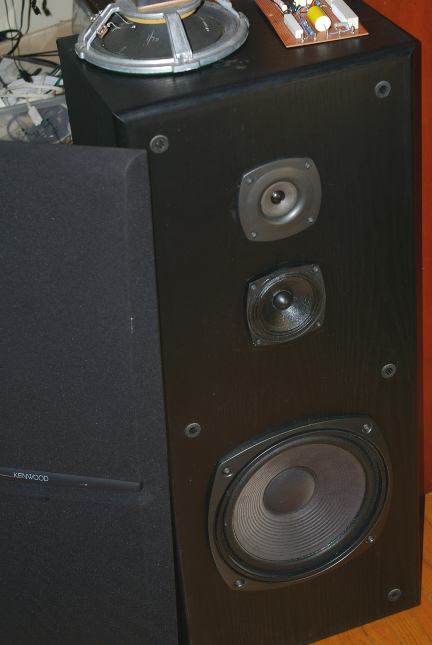
The JL-545 (B=black version) are a large rectangular, somewhat flattened but tall cabinet, with a 3-way paper-cone speaker system.

A surprisingly generous 10" woofer, a light back-sealed mid, and paper tweeter,
are driven by a grossly simple "crossover",
consisting of two electrolytic caps, a 4.7 for the mid, and a 3.3 for the tweet.
The specs given were:
70 watts (music power?)
40 - 20kHz,
crossovers: 2000 Hz (woof to mid), 5000 Hz (mid to tweet)
Also disappointing, was the emptiness and flimsiness of the cabinet,
lacking any reinforcement and/or any matting or stuffing.
There is a small round port on the upper back panel, which contributes to the strong bass.
In fact, the whole secret of the rich bottom end seems to be the large cabinet-size and port,
which is well-proportioned to the 10" woofer.
Once I got over the shocking cheapness of manufacture,
I quickly warmed up to the project.
There were also some 'good' surprises here:
(1) The woofer had an extra ceramic ring glued onto the back, which effectively increased the size of the magnet. It seemed obvious that they had taken a basically cheap woofer (10 watt?) and strengthened the flux and power (SPL?) by this trick. Of course the coil would stay the same current rating, but no doubt this was a cost-effective way to make for a tighter more efficient bass response.
(claimed Sensitivity: (SPL?) : 91 db / W at 1 m
(2) It would be easy to drastically improve the flatness of this cabinet by judicious reinforcement/damping, and stuffing. I was ready to rock!

(1) First I added a cross-brace offset about halfway down across the back of the cab, effectively cutting the sides and back in half, vibration-wise.
(2) Next I glued in strips of triangular cross-section 2x1" up and down the sides, top and bottom, and upper back.
(3) Finally, I added a closed wooden box around the midrange from behind, making a 'cabinet inside a cabinet' to isolate the midrange (More on this later). This was braced against the back by a glued-in 1x2" strut pressing it against the inside front. I also lined this mini-cab with foam.
After this, I also stuffed the box with pillow-stuffing/blanket-liner, to kill standing waves.
The result was astounding:
The walls and sides, when tapped, went from 'pook' (like wooden drums) to 'tink', like a very stiff thick box.
I was confident the response would be very flat now in the bass and mid.
A/B the JL-545B against some more recent but maybe also cheap 'digital-ready' pair of speakers (rather large, more than mere bookshelvers, but not quite full blown floor models).
Although I could hear that the 'digital ready' pair were cleaner and flatter, they simply didn't have the lively bass punch of the Kenwoods.
Also, the Kenwoods had a better, more real sounding midrange, with plenty of upper mid realism.
On the down side, the other speakers had a much clearer high end, while the Kenwoods sounded smeared or blurred, maybe a bit crunchy too. But the low SPL of the Kenwood tweeters masked most of this well, and made the Kenwoods sound musical.
Overall, the Kenwoods won out, with nice deep bass, almost boomy, and a live, warm upper mid in the vocal range. The other speakers sounded 'nasal' and so flat they were compressed horribly. Yet going the other way, the Kenwoods were clearly an effort, almost noticably fatiguing to listen to, while the other 'digital ready' speakers were effortless to listen to.
Against my better judgment (but in ine with my sense of another fun learning project), I walked off with the Kenwoods. I was convinced their larger boxes would make a better starting-point for a large livingroom floor-set.
The JL-545 (B=black version) are a large rectangular, somewhat flattened but tall cabinet, with a 3-way paper-cone speaker system.

A surprisingly generous 10" woofer, a light back-sealed mid, and paper tweeter,
are driven by a grossly simple "crossover",
consisting of two electrolytic caps, a 4.7 for the mid, and a 3.3 for the tweet.
The specs given were:
70 watts (music power?)
40 - 20kHz,
crossovers: 2000 Hz (woof to mid), 5000 Hz (mid to tweet)
Also disappointing, was the emptiness and flimsiness of the cabinet,
lacking any reinforcement and/or any matting or stuffing.
There is a small round port on the upper back panel, which contributes to the strong bass.
In fact, the whole secret of the rich bottom end seems to be the large cabinet-size and port,
which is well-proportioned to the 10" woofer.
Once I got over the shocking cheapness of manufacture,
I quickly warmed up to the project.
There were also some 'good' surprises here:
(1) The woofer had an extra ceramic ring glued onto the back, which effectively increased the size of the magnet. It seemed obvious that they had taken a basically cheap woofer (10 watt?) and strengthened the flux and power (SPL?) by this trick. Of course the coil would stay the same current rating, but no doubt this was a cost-effective way to make for a tighter more efficient bass response.
(claimed Sensitivity: (SPL?) : 91 db / W at 1 m
(2) It would be easy to drastically improve the flatness of this cabinet by judicious reinforcement/damping, and stuffing. I was ready to rock!

(1) First I added a cross-brace offset about halfway down across the back of the cab, effectively cutting the sides and back in half, vibration-wise.
(2) Next I glued in strips of triangular cross-section 2x1" up and down the sides, top and bottom, and upper back.
(3) Finally, I added a closed wooden box around the midrange from behind, making a 'cabinet inside a cabinet' to isolate the midrange (More on this later). This was braced against the back by a glued-in 1x2" strut pressing it against the inside front. I also lined this mini-cab with foam.
After this, I also stuffed the box with pillow-stuffing/blanket-liner, to kill standing waves.
The result was astounding:
The walls and sides, when tapped, went from 'pook' (like wooden drums) to 'tink', like a very stiff thick box.
I was confident the response would be very flat now in the bass and mid.
Subscribe to:
Posts (Atom)