All about Tubes, Tube Circuits, Tube Gear
Showing posts with label Bass Cabinet. Show all posts

Saturday, June 23, 2012

Marshall Cab (3)

Just an update:
I installed the 2 12" Pro Blue bass drivers,
and tried hooking up just one:
Wow!  So that is what good loud bass sounds like!


Wednesday, June 20, 2012

Fender Rumble 60 Upgrade


I just inherited this Rumble 60, and I note it seems to have an 8 ohm Fender Special musical instrument speaker.  However, this speaker is actually undersize compared to a regular Fender 12", and seems to be only about a 40 watt speaker.

Note the small magnet.


The cabinet could use reinforcing,
and it looks like I could reinforce corners/edges inside,
seal the box and port too:


Bass Reflex Cabinet w. slot along bottom:


9" deep X 15 3/8" wide x 15 1/4" high (16 3/4" at back) interior box,

= 2140 cubic inches (1.24 ft³, .035 m³ )

with port/slot = 3/4" high x 16" wide, (12 Sq. In.)
and about 7" deep. (84 cubic in. in volume).


On the other hand,
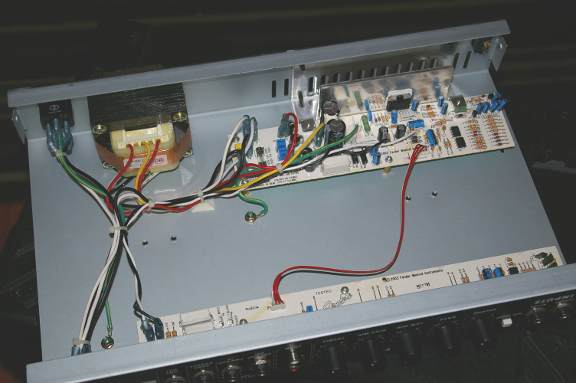
The chassis for the Rumble 60 (at least this one) isn't made of Aluminium! It seems to be soft steel.

Its solid, rectangular and just about perfect for a small 2-tube push-pull power section.

I'd have to build a separate wood cabinet for it (Marshall-style).

Click the image to open in full size.

Somebody maybe already got that idea, and sold a chassis on Ebay.

I'm thinking, - now that the Rumble 60 has been discontinued,
and it has gone down from $500 new to about $200 or less used,
it makes a good start-pack for a 'champ' project complete with speaker cabinet!.

I don't know if this speaker would satisfy a guitarist,
but the chassis should satisfy a DIYer!

 Okay here's a closer look:

Click the image to open in full size.

16.5 " wide x 9.75 " deep x 2.75 " (at back. 2.25" front) chassis


______________________________

Recommendations for Amp:

Chuck integrated chip-amp,
and build tube amp on chassis, mount it in separate Marshall-style box.

Ok so the chassis is 16.5" wide (without any sides),
and 10" deep (ignoring transformer bulge and knobs).

I'm guessing a separate 'head' box will be:

(inside: 16.75" x 12" deep (allow for knobs/fuses) x 8" (3" + at least 5"))

Add 3/4" ply (x2) box:

18.25" x 12 (or 13)" deep by 10" high.
You can use the metal speaker-grill (cut) as a front/back grid above the chassis / knobs, to keep fingers out of front and back, and have plywood top, bottom and sides.
Carpet (or woodfinish) and corners as desired.

Makes for a sweet looking 60w push-pull head.


------------------------------

Recommendations for Speaker Cabinet:
 
As it is, the cabinet has a horrible "honk/peak" on the low E string (G,G#),
and another one about an octave higher (Gb, G, G# smeared).

Its a very uneven bass response, almost unplayable in certain areas of the fretboard!

The four-knob EQ doesn't fix this,- not even in the ballpark.


I'm thinking: put a real 200 watt speaker in it,
seal the port with a plywood block,
maybe add a midrange speaker (in separate compartment) + crossover.

Reinforce cabinet walls with crossbraces,
and foam 3 sides inside to stop standing reflections.

 To update:


I've added wheels (a necessity with any amp larger than a 10watt).

Also:

I reinforced the inside with a cross-piece horizontal pine board about 1" thick and 4" wide, edgewise toward speaker-back, cutting back-panel in half. Screws in sides and back and glue to hold.

I added a 16" piece of 2x4 in bottom, after removing fruity lightshow panel, right on bottom and right against port-hole inside blocking it: glued and screwed from bottom/sides (1.5" screws).
Long-screws were used on ends (from side).

I used a spray-can of insulating-foam, filling port, corners and edges all around inside box. Worked well.

I replaced speaker and tested:

The two main resonances were still there, (49 Hz and 98 Hz), but a little less bad. Much of the cabinent distortion on other notes however were cleaned up, so this cabinet reinforcement is really worth doing.

I went back to my buddy at The Speaker Store, asked about a notch-filter. This was not good news, as the cap/inductor combo would require 150 mH (HUGE if aircore) and 20,000 - 40,000 uF caps. The cost was unjustifiable, and the coil was made of unobtainium.

But the good news is my speaker expert recommended
stuffing the cabinet full of quilt-stuffing material to kill all standing waves.
So I gutted a 'comforter/pillow' and stuffed cabinet and replaced speaker:


...FANTASTIC!
The two main resonances were about 80% killed off (still a slight and noticable peak/resonance but the bass guitar was actually playable and the notes near the 'resonance' weren't all blended together and indistinguishable.

Also, the whole bass fretboard was not only playable but sounded musically awesome (especially two-note stuff and octaves)!

Bass Guitar amp went from pure honky crap to sonic bliss.

Pull all your bass woofers, reinforce sides and stuff the box full!
You will be amazed.

Now the amp actually doesn't sound so bad (for a transistor),
although the EQ is still crap.

In an ordinary room (practice, coffeeshops) it seems more than adequate.
Also seems to work good as a small guitar amp (maybe better than as a bass).

Still, speaker seems underpower for useful playing.

I'm now thinking of just adding a tube-circuit (12ax7 etc.) inside the box for an 'overdrive' channel:
You don't have to make a separate 'head' for this, to get a 'tube' sound.

I will get back again on this.

 "you mean, you sealed that .75" gap on the bottom of front?
isn't that needed to let the pressure out, so speaker won't blow up? "

Yes I blocked that, to get a smoother frequency response.


No, unless you are pumping ridiculous levels of power into it.

The sealed cabinet should limit the excursion somewhat,
protecting the speaker against physical overload.

I think there is some problems with paper-accordion surrounds (i.e., guitar speakers) handling extreme excursions of bass,
and supposedly the surrounds can tear.
It may be that this speaker (the original equipment) is susceptable to this, if pushed:
It certainly looks rather underrated (small magnet etc.) for a bass speaker.
But I think Fender would have put a speaker in that can handle bass,
since they contract speaker-makers to customize their speaker requirements.

I haven't overdriven it, but no one should with a small cab/speaker like this. Its strictly for practice and coffee-shops.

I was tempted to drop in a guitar-speaker (higher power) but resisted the temptation, since guitar-speakers are not made for bass-excursion.

I am still tempted to further modify the cab:

That is, put a Karlson-skirt on it to greatly amplify the loudness for a given wattage. If this was done properly,
the amp/speaker combo could probably power a rock-band / bar scene.

Tuesday, June 19, 2012

Woofer Distortion 101


Recently there was a discussion in regard to speaker distortion.  It was about what happens when you have two woofers in one box, but have them crossed-over at different points.

A poster wasn't able to articulate his point, and as a result of some confusing expressions, left people thinking he was 'trolling'.

In fact, he was right on the essential point, which I'm going to illustrate with some diagrams here:

Diagram 1:  Two Separate Cabinets vs. One Cabinet


What actually happens when two woofers share the same cabinet?
Well, in the above diagram, there isn't much difference between the two situations.   If this isn't clear, the following diagram should help out:

Diagram 2:  Front and Back Radiation

Above we assume that both speakers are wired "in phase", which means that regardless of whether they are in series or in parallel, the coils are set so that a positive voltage across the marked terminals makes both speakers move outward, while a negative voltage makes the speakers move in.  You can test this with a small battery.

The sound waves are pushed simultaneously in the same direction out the front, and they make a large parallel wavefront, twice as powerful as either speaker alone.   In the back, a sound wave of opposite phase is pressed against every wall of the inside of the cabinet, with only a short delay from the speaker to the cabinet-wall.

By inspection, we may note that the sound pressure is applied equally to both sides of the separating wall in the first cabinet.  When the speakers are moving out, they create suction inside, and when the speakers are sucking inward, they increase pressure in the cabinet.   That is, while the action inside the cabinet is the opposite of that outside,  the same thing happens in both compartments at the same time, either high pressure in both, or low pressure.

 This means that the pressure is equal on both sides of the separating wall at all times, and according to classical mechanics, there is then no net-force on the separating panel, and no energy will be exchanged between the two partitions.   From this it should make no difference if the wall is removed, as in the speaker cabinet on the right.  The forces (both pressure and vacuum) are equal and opposite, and cancel inside the box.


 Distortion from Excursion

Another thing to observe, is that the loudness of a sound of a given frequency will be based on how much air is pushed, or the area of the woofer surface.  It follows that doubling the number of speakers will give us one of two options.

(1)  If the two speakers are in parallel, and are presented with the same voltage (speakers are voltage-operated devices), we will have twice the air and twice the power used, which means a lot more loudness.

(2)  Alternately, and this is much more interesting, we can instead put half the power into each speaker, and get the same volume, with each speaker doing half the work.  So what?  Well, it means that each speaker only needs to physically move half as much, for the pair to move the same amount of air.

Why is (2) significant?  If speakers move too much, the result is distortion.   Speakers have a limited excursion, that is, they can only move so much before they put up too much resistance, and start either clipping the signal, or they might get out of control.    The excursion is a measure of headroom, or freedom to respond to signals.  If the speaker is already playing a loud bass-note for instance, and is moving at its maximum swing, it can't respond when another musical note is added on top.  There is no more headroom, and the new signal is either attenuated, or otherwise distorted.  This can be referred to as Intermodulation (or I.M.) distortion, and happens at higher volumes as the speaker puts up more resistance and changes the wave-shape, which automatically adds harmonics or sidebands, and attenuates other frequencies.

Splitting the bass-load between two speakers will then cut back a large amount of distortion, and leave headroom for more  musical input, with much less I.M. distortion.   Of course this is very similar to simply using a larger speaker, which can then output more bass with less motion, and less distortion.

Thus many people might presume that this can only be a good thing, and that there is no trade-off in musical quality by doubling the speakers (other than cost!).  We will see if that is always the case, below.


All this is just the necessary background to the discussion at hand, which originally took place on the DIYaudio forum. 

Here is the link, although some of the discussion may have been subsequently deleted.

3.5 way speaker design, should I put the woofers together?

 ----------------------------------------------
In the original discussion, the speaker builder wanted to have two speakers, but with only one speaker  carrying some midrange also.  This is done simply by having a different crossover-point for each woofer.  One speaker would just carry the bass, while the other would carry both bass and lower mids.

The argument was as to whether or not there was a musical drawback to the method of doubling the woofer, operating the two woofers across different bandwidths, while having them share the same box.

The poster felt that there would be distortion because of this, and he was essentially right. 

Diagram 3:  Midrange Bleed-Through
Lets assume the top speaker is the one that will carry the extra midrange musical content.  In the separate compartments, the out-of-phase back-wave from the speaker would mostly be absorbed by the box, and only a small amount would feedback to the originating speaker, resisting and affecting the signal radiating out the front.

Now look at the diagram on the right:

Without the barrier, the back-wave from the top speaker will also reach the bottom speaker, and radiate out through the cone.  From the point of view of the cone, it matters not whether the signal is imposed upon it from an electrical signal via the coil, or mechanically from the back via the air.  The cone will move (vibrate), and the sound will radiate out.  The cone is a relatively thin and pervious veil over the lower hole, and permits sound to escape the box.


The Flange-Effect

However, this new copy of the midrange signal is not identical to the original.  It has now been time-delayed, much as the sound from a port is.  Here however, the midrange sounds are very short wavelengths, and will alternately cancel and reinforce the original signal, depending upon wavelength.  This acts as a fixed-frequency comb-filter, as well as a phase-shifting filter.

Compounding this comb-filter/delay flanging effect will be the secondary I.M. distortion added by the moving lower speaker, pumping bass.  Almost the same amount of I.M. distortion being added to the midrange already via the top speaker will also be added to the inverted signal radiating out the bottom.

Diagram 4: Intermodulation Distortion


This does not negate the gains achieved by doubling the bass-woofer.  But now the midrange being reproduced by the system is accumulating distortion of an entirely different kind than would have originally been the case for a single driver with no radiator or port.  And it should be remembered that the same gains in lowering I.M. distortion could have been achieved with a single larger woofer.

Thus two questions need to be asked: 

(1)  Why would you choose to have two smaller woofers rather than one larger one?   The answer ought to be, that some other benefit is achieved, namely a different frequency response, or cabinet resonance, or speaker specs, which would move the builder to take on the extra work of designing for two speakers.

(2)  Secondly, can anything be done to minimize the drawbacks introduced by two speakers in one cabinet?   Well, the answer is a definite yes!  The simple act of dividing the cabinet into two compartments, and stuffing the top with absorbent materials, should eliminate the undesirable 'flanging effect' we can expect from single compartment.

Thus, that poster was right when he insisted that the design could be significantly improved by partitioning the cabinet.


Thursday, June 14, 2012

Marshall Cab Build (2)


  Now supposing I were to put just two 12" bass speakers in this cabinet.

The question then becomes, just where should they go?

The most significant alignment has to do with the distance from the floor.

I found this interesting bit of info on distance of speaker to floor:


Quote:
Optimum frequency response curves in the bass range.


a. The influence of the floor reflection

Depending on the woofers' height over the floor, the contribution from the floor will be in phase with the direct radiation from the driver up to a higher or lower frequency. Some examples are shown below.

Height: 70 cm (29 in") > 250 Hz (1st cancellation at approximately 500 Hz).
Height: 30 cm (11.8") > 600 Hz (1st cancellation at approximately 1200 Hz).
Height: 10 cm > 1800 Hz (1st cancellation at approximately 3600 Hz).

Below this frequency the level will be elevated approximately 2-6 dB compared to higher frequencies. To be more specific, the level is elevated 6 dB when the reflection is in phase with the direct radiation and, on an average, it is elevated 3 dB in the higher range where the reflection appears in random phase.

Both the 6 dB increase at low frequencies and the 3 dB increase at higher frequencies can be less depending on how elastic the reflective surface is (for low frequencies) and how absorbing it is (for high frequencies). Therefore, the interval is 2-6 dB.


b. The cavity effect of the room
Real rooms contribute with more bass increase than if they had been a "theatre box" open in the front (this is not a "Voice of the Theatre" speaker box, but the place you sit in a theatre). In practice, there are of course many variations between different listening rooms, but it is possible to draw a "typical room curve". From it you can also see some typical floor modifications.

Click the image to open in full size.
Comments: The influences of the standing waves in the room are not included in these curves for several reasons. Firstly, they belong to the listener's acoustic in the "theatre box". Secondly, there are no "general standing waves"; all rooms are unique. It should also be pointed out that a room-adapted speaker will have an inverted frequency response compared with these curves. You can also see that you do not have to worry about the floor reflection if the woofer is placed low to the ground and the midrange is placed high and the crossover point is placed between the floor knees of the two drivers. You should, however, see to it that the woofer has 2-4 dB less output in its free field response, without the help from the floor.

Height: 70 cm > 250 Hz (1st cancellation at approximately 500 Hz).
Height: 30 cm > 600 Hz (1st cancellation at approximately 1200 Hz).
Height: 10 cm > 1800 Hz (1st cancellation at approximately 3600 Hz).


(the upper position in my 4 x 12" cab is about 23", or 55 cm) >= 700 Hz?)

Judging from this tidbit, it looks like I could fine-tune
the response just a bit further,
by mounting the speakers high enough from the floor,
to say reinforce at the low B or just above it on a 5-string!

I don't know how he is calculating this,
but it looks like an approximate curve could be extended to say 40 Hz, and maybe the speaker would still be inside the cabinet!

Oops nevermind: actually it looks like I'd have to position the cabinet about 2-3 feet off the ground!

In the lower position (about 7" from floor) it looks like maybe a 5kHz boost!


Here is my build update:

Pic 1 shows me adding a permanent divide between the two sides.
This allows one 12" bass speaker to drive each side, and have its own box.


The divider is also 1" plywood from the same sheet of laminated tabletop I got free.
This makes the two sides totally independent, and also allows lots of glue-surface
and screw-down wood to sink into to hold both the front and back panels rigid,
and attached to each other across the center.

Pic 2 shows 2x2 (really 1.5 x 1.5" pine/spruce along the top and bottom edge
for sealing and screwing down the front plate(s).


Note also the chunk of 2" plywood triangle in the center back,
to give the screws on the back panel something to bite into.


Pic 3 shows a detail of some triangular glued supports to keep the sides and back connected.


Pic 4 below shows how a half-panel can be easily substituted to make the cabinet bass/guitar combo,
or for comparing different guitar speaker-pairs.
Panels can be put in vertically or horizontally, so for instance,
I only have to cut 2 12" holes, one in each panel to have a complete bass cabinet.
Extra panels are easy to make, for swapping in and out!


You will notice the rabbit has expressed his usual dim view of speaker projects.
In fact he is quite unimpressed with the slippery top, although it is water-proof,
and probably rabbit-proof too.


Pic 5 shows the bottom panel (same as top). They receive some stiffness from the side supports, but tapping various sides and compartment walls will reveal rattles, weak gluing, unusual resonance problems and/or areas needing more stiffness/support.


In this case, the bottom and top are still sounding a little like
the "Three Stooges Pop", so I'll need to dampen those two panels at least.
The side panels are stiff as a board, from the cross-divider.


I estimate I lost about a half a cubic foot of internal space adding these supports,
but I also gained most of it back by simply letting the 3/8" plywood front-panel supports to raise the front-panel forward over 3/8" (i.e., 3' x 3' front = 9 sq ft x 3/8"). 


Because the front panel at the moment is 1" thick,
there is plenty of room for front-mounting speakers
and also sinking them into the top with a ridge/lip to make them flush with the front.

All the wood I got free so far, within a block and a half of my house.
The plywood tabletop I carried home, and probably would have
had to carry it the same distance to and from my car if I had bought it...

The other wood is from a dumpster bin at a house-reno down the street.
I got plenty of 3/8" plywood scraps and 2x2" strips, and 2x4 end-pieces,
and old (real) 2x4s too, for fixing my garage, which they were tossing.

My cost so far:

handles $9 each = $18.00 (Speaker Shop)
wheels $5 each = $20.00 (Home Depot)
screws $5?

One circular saw and extra fine blade $100.00 (however, I'll be using this for more projects!)

Also, I may buy a plunge-router (used at pawnshop) and blade to do speaker cutouts.
(estimate $50?)

Call it $150 in parts/tools, and a couple of days fooling around with son building it (priceless!)

They are selling a ready-made carpeted box with handles (no wheels) out of chipboard (no supports),
for about $160. So I'm still ahead, and its a great DIY project!
I would have had to do the same amount of reinforcing to the premade cabinet, and add wheels...

Marshall Cab Build (1)

I followed the basic plans for a straight 4x12" marshall stack cabinet.

Only I plan to seal the back up and reinforce it,
and mount the speakers so they are removable from the front.

Thing is, I'd like this cabinet to work as a bass-cabinet too,
and have it go down to about 30 Hz for a 5-string bass.

 I got a few ideas from here:

Always be sure to select a port size that is roughly half the diameter of the driver you will be using. This prevents wind noise in the tube, which is kind of like blowing across the opening of a partially filled bottle, and hearing the resonate hum. I like to use 10 inch drivers, with a port tube size of 3 to 4 inches.
One design I finished recently used 4, 10" Dayton drivers, and used a pair of 4" vent tubes approximately 7 inches long each. The cabinet dimensions were roughly 24" by 24" wide and high, and the depth was about 13". Although the cabinet is quite large and heavy, it has a overall F3 of 29 Hz, which allows a five string bass to really push out the low B string with authority.


 http://www.duncanamps.com/technical/speaker_cab.html

 Now the thing is, I've already built my basic cabinet,

which is now 30" x 30" x 12 1/2" outside,
out of 1" thick counter-top coated real plywood.
(someone threw out a 3 1/2 x 7 ' sheet! formerly a table)

Inner dimensions 28" x 28 3/8" x about 11" = 5.026 cubic feet

or:

27.9 cm x 71.9 cm x 71.1 cm = 142627.311 cm3 = 0.142627311 m3 = 142.627311 Liters.

I used the following calculator to see what the standing wave frequencies of this space was:

mh-audio.nl

Oddly, this cabinet looks pretty good, in spite of two dimensions being very close.

I plan to reinforce the cabinet more, and use some deadening sealing foam and stuffing to remove resonances/reflections.

The front panel will be mounted about an inch in
to allow front-mounting the speakers from the front.


I'm wondering how to pick speakers, and/or a porting option,
in order to give a very flat response down to about 35 Hz.


-----------------------

I'm not sure what to do next, or what speakers I should be looking at.
Here are some good comments from the thread-posters:

 "Most bass guitar 4x10 cabs have 1.2 - 1.5 cf per driver so your cabinet is about right. "  The 10 inch drivers allow a lower system resonance (all else being equal).
 A 12" driver requires more cabinet volume than a 10" driver, so, comparitively, the 10" sees a larger cabinet, so the system resonance will be lower, giving more bass extension."
 you already have a ~5 cubic foot enclosure and you need to put some speakers in it.

My friend used a couple of these in some sealed cab for his personal system

Tang Band WQ-1858 12" Aluminum Subwoofer 264-897

Very low Fs of 20Hz, also large xmax of 13mm. Vas is a bit big so thats only two drivers, not 4

 Thing is, the more Xmax you go for, the lower the sensitivity of the resulting driver.

Forget about 30hz. Traditionally, bass cabinets never go that low, and if they do, you will have problems. They often start rolling off around 100. You are hearing the harmonics of those notes in the video, with very little fundamental.

Using a sealed cabinet will make the bass response roll off more gradually as it goes deeper, which will generally sound 'tighter' in a room."

----------------------------

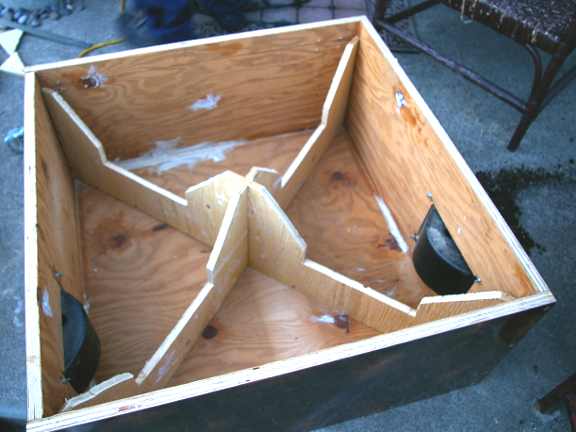
I came up with a real strong front/back support scheme:
The St.Andrews cross-diagonals.


Click the image to open in full size.

This is like the Greek-cross idea, but actually better I think,
because it doesn't divide up the back resonating drum-head
into smaller drumheads.
Instead, the triangular shapes quickly dampen and kill resonances
and turn standing waves into quiet heat.

Also, the cross supports the front panel in five places, including
the front center, the most important zone. I am also toying with
adding 2x4 or 2x2 struts at 12 o-clock, 3 oclock, 6 oclock and 9 oclock,
about half-way from center, to further support the front-panel at its weakest points.

As well, there will be a supporting rim (probably 2x2 (1.5 really)) running the inside perimeter.

There will also be diagonal treatments of the for sides/top/bottom, to triangulize and deaden those.

Finally, I will add heavy felt on the sides and foam the corners
and stuff the cabinet with medium weight pillow/comforter fluff.

What think ye?

Now is the time to make construction suggestions.
The back, sides, front are all 1" plywood covered with counter-top laminate.

My friend at the speaker shop suggested avoiding wheels, for a bass cab.
So I came up with this ingenious idea: Put wheels on bottom (relative to handles)
and put rubber feet on side (flip on side for playing)!
Ta Da! see picture 3.

Wednesday, June 13, 2012

Karlson Bass Cab Project (1)


Here's the challenge:

The size of the outer box is fixed:


I want to turn it into a good high-power (SPL) Bass Cabinet.

I would use either a 12" like the MCM (price and specs are good!),
or a 15" woofer.

The shape seems to cry out "folded horn", "tapped horn", "Karlson-mod" or something!

It should be loud enough for medium/small gigs,
but not require scads of amp watts to drive it, hence my 'horn-tech' appeal.

Here's the idea:

I turn the top half of the cab into a bass-guitar-cab,
with the speakers facing down.
To protect the speakers during transport,
you could have a shorting-jack to freeze the cones.

Now the bottom is like a speaker-cover with wheels.

You wheel it around face-down,
but for playing you unclip it from the wheels/bottom,
and tip it on its side.

The inside dimensions are about 20" x 26" x 14" = 4.2 cu. ft.

Minus some reinforcement/folding hornwork, say about 4 cu.ft. or less.

Is that enough for a couple of 12" or a 15"?

It needs a good cleaning out.
It had some drum parts, and alot of deteriorating foam in it.

Please, those of you who love THs, or Karlsons, or FHs,
give me a clue in the way of a usable blueprint.

I'm an ok carpenter, but I'm not a pro speaker-builder!

It could be in the form of a slip-in inner cabinet,
or just a framework using the outer-cab itself, with reinforcements.

All ideas welcome! 

...

Okay, I just measured the inside of lid, and it will allow
an additional (outer dimensions)

20" w x 26" t x 6" deep extension, of lets say 3/4" plywood front
18.5" x 24.5" x 6" (internal) = 2379.5 cu in = 1.38 cu ft.

That brings the cab to well over 5 cu ft of space available internally.

Thats the same or larger than a Marshall cab.
i.e., it should support 4 x 10" and give good bass,
or 2 x 12" as a simple closed cab (or small ported).

but I'm still thinking there's now room in here for a Karlson... 

Here's what I was picturing:


This frame would snug-fit inside the box, extending it 6 inches.
2 inches would overlap, for something to screw to (total of 8 inches).

This makes the box effectively about 20"x20" x 26" (external).