All about Tubes, Tube Circuits, Tube Gear
Showing posts with label distortion. Show all posts

Tuesday, June 19, 2012

Woofer Distortion 101


Recently there was a discussion in regard to speaker distortion.  It was about what happens when you have two woofers in one box, but have them crossed-over at different points.

A poster wasn't able to articulate his point, and as a result of some confusing expressions, left people thinking he was 'trolling'.

In fact, he was right on the essential point, which I'm going to illustrate with some diagrams here:

Diagram 1:  Two Separate Cabinets vs. One Cabinet


What actually happens when two woofers share the same cabinet?
Well, in the above diagram, there isn't much difference between the two situations.   If this isn't clear, the following diagram should help out:

Diagram 2:  Front and Back Radiation

Above we assume that both speakers are wired "in phase", which means that regardless of whether they are in series or in parallel, the coils are set so that a positive voltage across the marked terminals makes both speakers move outward, while a negative voltage makes the speakers move in.  You can test this with a small battery.

The sound waves are pushed simultaneously in the same direction out the front, and they make a large parallel wavefront, twice as powerful as either speaker alone.   In the back, a sound wave of opposite phase is pressed against every wall of the inside of the cabinet, with only a short delay from the speaker to the cabinet-wall.

By inspection, we may note that the sound pressure is applied equally to both sides of the separating wall in the first cabinet.  When the speakers are moving out, they create suction inside, and when the speakers are sucking inward, they increase pressure in the cabinet.   That is, while the action inside the cabinet is the opposite of that outside,  the same thing happens in both compartments at the same time, either high pressure in both, or low pressure.

 This means that the pressure is equal on both sides of the separating wall at all times, and according to classical mechanics, there is then no net-force on the separating panel, and no energy will be exchanged between the two partitions.   From this it should make no difference if the wall is removed, as in the speaker cabinet on the right.  The forces (both pressure and vacuum) are equal and opposite, and cancel inside the box.


 Distortion from Excursion

Another thing to observe, is that the loudness of a sound of a given frequency will be based on how much air is pushed, or the area of the woofer surface.  It follows that doubling the number of speakers will give us one of two options.

(1)  If the two speakers are in parallel, and are presented with the same voltage (speakers are voltage-operated devices), we will have twice the air and twice the power used, which means a lot more loudness.

(2)  Alternately, and this is much more interesting, we can instead put half the power into each speaker, and get the same volume, with each speaker doing half the work.  So what?  Well, it means that each speaker only needs to physically move half as much, for the pair to move the same amount of air.

Why is (2) significant?  If speakers move too much, the result is distortion.   Speakers have a limited excursion, that is, they can only move so much before they put up too much resistance, and start either clipping the signal, or they might get out of control.    The excursion is a measure of headroom, or freedom to respond to signals.  If the speaker is already playing a loud bass-note for instance, and is moving at its maximum swing, it can't respond when another musical note is added on top.  There is no more headroom, and the new signal is either attenuated, or otherwise distorted.  This can be referred to as Intermodulation (or I.M.) distortion, and happens at higher volumes as the speaker puts up more resistance and changes the wave-shape, which automatically adds harmonics or sidebands, and attenuates other frequencies.

Splitting the bass-load between two speakers will then cut back a large amount of distortion, and leave headroom for more  musical input, with much less I.M. distortion.   Of course this is very similar to simply using a larger speaker, which can then output more bass with less motion, and less distortion.

Thus many people might presume that this can only be a good thing, and that there is no trade-off in musical quality by doubling the speakers (other than cost!).  We will see if that is always the case, below.


All this is just the necessary background to the discussion at hand, which originally took place on the DIYaudio forum. 

Here is the link, although some of the discussion may have been subsequently deleted.

3.5 way speaker design, should I put the woofers together?

 ----------------------------------------------
In the original discussion, the speaker builder wanted to have two speakers, but with only one speaker  carrying some midrange also.  This is done simply by having a different crossover-point for each woofer.  One speaker would just carry the bass, while the other would carry both bass and lower mids.

The argument was as to whether or not there was a musical drawback to the method of doubling the woofer, operating the two woofers across different bandwidths, while having them share the same box.

The poster felt that there would be distortion because of this, and he was essentially right. 

Diagram 3:  Midrange Bleed-Through
Lets assume the top speaker is the one that will carry the extra midrange musical content.  In the separate compartments, the out-of-phase back-wave from the speaker would mostly be absorbed by the box, and only a small amount would feedback to the originating speaker, resisting and affecting the signal radiating out the front.

Now look at the diagram on the right:

Without the barrier, the back-wave from the top speaker will also reach the bottom speaker, and radiate out through the cone.  From the point of view of the cone, it matters not whether the signal is imposed upon it from an electrical signal via the coil, or mechanically from the back via the air.  The cone will move (vibrate), and the sound will radiate out.  The cone is a relatively thin and pervious veil over the lower hole, and permits sound to escape the box.


The Flange-Effect

However, this new copy of the midrange signal is not identical to the original.  It has now been time-delayed, much as the sound from a port is.  Here however, the midrange sounds are very short wavelengths, and will alternately cancel and reinforce the original signal, depending upon wavelength.  This acts as a fixed-frequency comb-filter, as well as a phase-shifting filter.

Compounding this comb-filter/delay flanging effect will be the secondary I.M. distortion added by the moving lower speaker, pumping bass.  Almost the same amount of I.M. distortion being added to the midrange already via the top speaker will also be added to the inverted signal radiating out the bottom.

Diagram 4: Intermodulation Distortion


This does not negate the gains achieved by doubling the bass-woofer.  But now the midrange being reproduced by the system is accumulating distortion of an entirely different kind than would have originally been the case for a single driver with no radiator or port.  And it should be remembered that the same gains in lowering I.M. distortion could have been achieved with a single larger woofer.

Thus two questions need to be asked: 

(1)  Why would you choose to have two smaller woofers rather than one larger one?   The answer ought to be, that some other benefit is achieved, namely a different frequency response, or cabinet resonance, or speaker specs, which would move the builder to take on the extra work of designing for two speakers.

(2)  Secondly, can anything be done to minimize the drawbacks introduced by two speakers in one cabinet?   Well, the answer is a definite yes!  The simple act of dividing the cabinet into two compartments, and stuffing the top with absorbent materials, should eliminate the undesirable 'flanging effect' we can expect from single compartment.

Thus, that poster was right when he insisted that the design could be significantly improved by partitioning the cabinet.


Wednesday, June 13, 2012

The Grill Effect: Woofer Covers (4)

Reliable Hardware quantifies how acoustically open their various flat stock is. The more open to air flow a grill is, the less it reflects output back at the cone, and the lighter it will be for its type. I would never recommend anything less than 50% open.
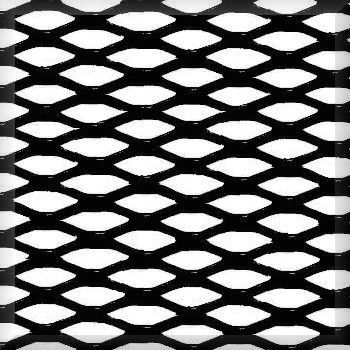
expanded diamond cut - 63% open

Click the image to open in full size.

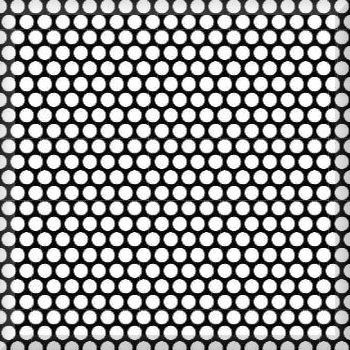
perforated 5/32" round hole - 62.4% open

Click the image to open in full size.
and in distant third:
perforated 3/8" square hole - 56.2% open

Click the image to open in full size.

After doing a lot of web crawling these seem to be the way to go for full-coverage metal jackets. My preference used to be the expanded diamond cut, but the 5/32 round hole grill has taken its place. Downsides to Reliable? Minimum order there is $25, and shipping for only one grill is rather high. So you may want to order something else there too

The Grill Effect: Woofer Covers (3)

To give an idea of how much air is actually blocked, Nickerson made the following calculations:


Quote:
"I just did some calculations on a 4"x4" section of speaker grille.My speakers contains 121 1/4" circular holes per 4"x4" section,so if my math is right ,that is a total of about 5.93 square inches of 'circular holes' punched into a total area of 16 square inches which means that about 62% of the area immediately in front of my speaker is covered by what appears to be about 3/32" steel plate.
I am curious if this amount of metal directly in front of a speaker could have a noticably degrading effect that could be improved by either removing the grille or replacing it with something lighter duty?
Has anyone explored this further and come up with any conclusions?
"

Speaker Grille Thread
\In the same thread, Tom Young added this:

Quote:
The best I have found in a metal grill material with anything approaching enough protection is from a McNichols perforated steel, 12 guage and with 1/4" holes with a resulting 58% transparency.

Given the lack of flat area facing the drivers (because the holes have rounded edges and are so densely packed), I haven't observed much, if any, HF reflection from this stuff. I have observed reflected HF energy in other grill materials including most of the available purpose-built speaker grill cloth from Accustone, etc. (which surprised me).

Your calculations appear to result in 48% transparency. I personally would try to improve this. Go to www.micnichols.com and then select "Round Hole", then "Round Hole Pattern", then select from materials "plain steel" and then hit "view stock list" and after this loads, scroll down to 1/4" hole size, 5/16" hole centers, staggered, 12 gauage and 58% open area.

That's probably the best you can do. Be prepared to spend some good money for the stock and then go through the process of degreasing the metal, cutting it to size and then finishing it. Obviously for small batches this is probably too much cost and effort."


Tom Young
Electroacoustic Design Services
Oxford CT
Some other handy notes from there:

Quote:
I have gotten a few sheets of perf metal from Mc-Nichols for the floor monitors I have built. I went with the 5/32nd hole size with 3/16th spacing and that figured out to be 63% open area. But that size is only available in 16 gauge thickness. If I were doing punk shows I would have gone with a much heavier gauge and less open area! But the 16 is easy to form on curves.
I also have a layer of 1/4 inch acoustic foam on the underside of the perf metal.

Mike Caldwell

Quote:
Well, this whole thread got me wondering, since no one posted any real numbers, curves, etc, derived from actual tests - only hearsay. So last weekend, we ran some tests using CLIO on a brand new custom monitor, consisting of a JBL 2206H LF, 2426J HF on a JBL PT horn, custom crossover at 1200hz, and punched-metal grille material identical to the current stuff JBL uses, with the ~1/4" closely spaced holes.

It was a real eye opener! High frequency response actually appeard *stronger* with the grille in place! We ran the test a number of times, just to verify, and no, we didn't have the curves mixed up. All we can come up with is that the grille must somehow increase high-frequency diffraction. The mic was placed directly front and center, about 1 meter away. The room itself was fairly dead.

If anyone can come up with some other explanation, I'm all ears. Curves posted below - W/O grill = green, W/grille = red.

John


..
In the earlier graph, the grille was screwed down directly to the wood, which resulted in a metallic ringing sound when tapping the grille. I'm wondering if this is what caused the earlier, unexpected result? For these later tests, the grille was isolated from the cabinet by foam gasket material on all edges, which eliminated the ringing. Also, these later tests were done without the 1/6 octave smoothing, and low frequencies were windowed out.

I think it clearly can be stated that grilles of this type likely introduce comb filtering, at least at higher frequencies:
...
This latest series of tests show that the earlier results I posted were apparently not too accurate, and that grilles can have a negative, if somewhat minor effect,


John 

The Grill Effect: Woofer Covers (2)

One can see from the typical grill pattern how much air is being blocked:

Click the image to open in full size.

Fender has been using the above style on their "Rumble" bass amps,
and it looks stylish with careful folding, but it blocks a lot of air....


Something like this below would be better, blocking less air:

Click the image to open in full size.

But my concern here is still that wind-noise might be generated by the sharp corners and edges.


Something more promising is this:

Click the image to open in full size.
This is actually offered as speaker-grill material.

  • Product: Speaker Mesh
  • Model Number: TY15-18

Encouraging, but perhaps still not light enough in my mind.


Another popular style is as below:

Click the image to open in full size.

This is a type of cut and stretched grill made of sheetmetal.
The protection is rather good, especially in smaller hole formats,
but the drawback is that this is like a very sharp cheese-grater!
You can really injure yourself on these, even when painted,
and I'm still dubious of the amount of air-blockage and wind-noise potential,
although the angled flat-spaces prevent direct reflections back into the speaker.

It has an ugly look, unless painted black and also the wood etc. see-through is also treated with black paint.
Using light-blocking cloth might be self-defeating in terms of trying to minimize wind-resistance.

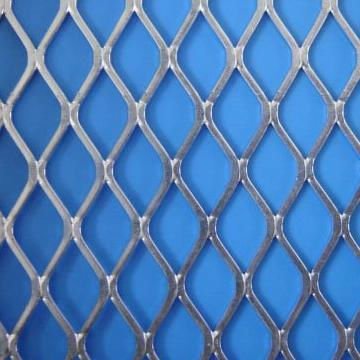
I'm still thinking even more space, like this over-stretched pattern below:

expanded metal for bbq grill


Click the image to open in full size.

Quote:
Expanded Steel Grille - Black (1220mm x 914mm x 1mm)
Decorative Steel Expanded Metal Mesh. Black.
Expanded Metal Mesh:
1.specifications:
Material: Thickness: 0.3 to 9mm
Long way of pitch: 3 to 200mm
Short way of pitch: 3 to 80mm
2.Materials: steel plate, stainless steel plate, aluminum plate, titanium plate, lead plate, nickel plate, and more
.
3.Process: Punched into holes of diamond shape, square, round, triangle, scale hole.
4.General Use:Used in agriculture, industry, fencing, outdoor furniture, speaker grills, machine and window guards, shelving and racks, security walls, and more.With good strength, wear resistance and nice looking, expanded sheet metal mainly serves to construction of railway, roads, buildings; also protection of machines, electrical appliances, windows.
Expanded metal mesh :long way is 3-200mm ,short way is 3-80mm ,thickness is 0.3-9mm .
But the problem now would be how to buy in small quantities.
This kind of stuff is custom-made and ordered by the skid-full.

The Grill Effect: Woofer Covers

This is not about grill cloths.
I'm assuming that those vary widely, and essentially soften the high end (treble),
with the lighter the fabric, the sparser the weave, the better.

I'm talking now about bass woofer screens, made of metal.
These appear to physically block half the radiating area or more.
I'm guessing that these metal grills cause significant effects:


(1) They must cause half-power size reflections back into the speaker cone, and 'shadow' cancellation at odd frequencies, especially for woofers that are going up to 120 - 1200 Hz.

(2) They must cause sound wave diffractions around the grill pattern, and perhaps add harmonic or intermodulation distortion to the original sound-waves.

(3) They must also possibly contribute "whistles", i.e., wind noises, especially with loud subwoofers and large excursion speakers.

This so far is just in my head.

But I was thinking that you could have almost as good protection (which is the main purpose for me, as opposed to looks, which are always dubious) with thin metal screening,
i.e., protection from pencil-poking, cap cave-ins, and furniture corners, falling drunks etc.,
But with a coarse, but thin metal screen there should be a lot less effect on sound(?).

I'm interested to hear others' experiences in this area,
and product evaluations, because I see little out there in the minimalist direction.

I wish they'd just make cheap covers for say 10" / 12" woofers that were black, see-through, and of a light enough gauge to be of no concern.

Taking covers on and off is a needless creation of non-productive labor,
and all the screens I've seen so far block way too much,
and I am thinking a thin metal screen would be as protective in 90% of accidents.
Also, prices (with shipping) are all over the map, but generally way too expensive (as much as drivers!).
What are manufacturers thinking?
Why would I pay as much for a grill as for an expensive, carefully engineered speaker driver, made of exotic components?

Examples:

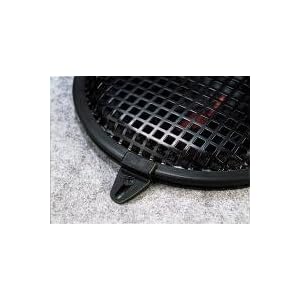
Worst-Looking and probably worst performance:
Click the image to open in full size.
12" Waffle speaker grill ($5.95 + $7.00 shipping)

+points: cheap, protects from most accidents.

- points: Doesn't protect from pencil-pokes, wires, chopsticks, or drink spills.


Moderately Better:

Click the image to open in full size.
12" Subwoofer grills ($25.20/pair, $20 shipping = $24 ea)

+points: Slightly better looking, better protection
- points: I can by a good woofer for the same price.


Best Found So Far:

Click the image to open in full size.
Two-Piece 12" Grill: ($18 + $20 Shipping = $38 ea! minor break on shipping quantities)

+ points: Best looking, best protection from pokes and spills.

- points: Still blocks air movement very significantly. Price is ridiculous.

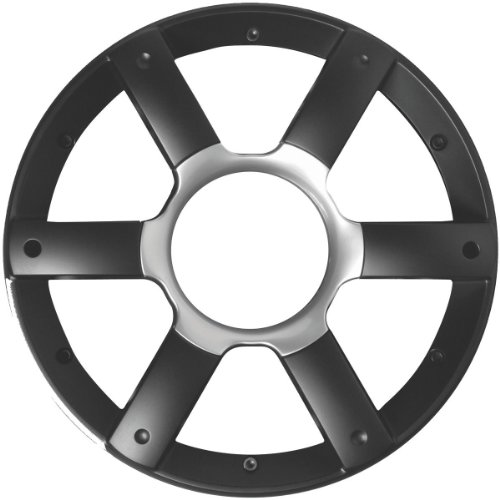
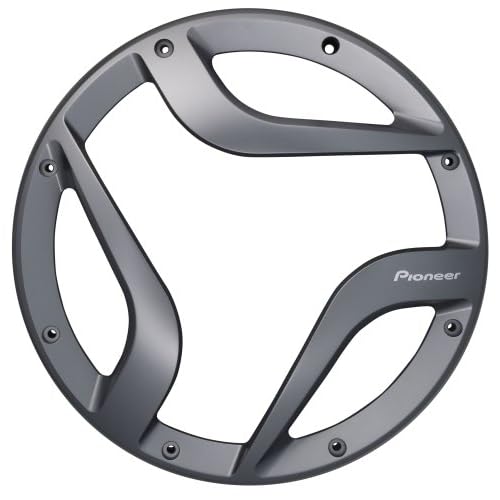
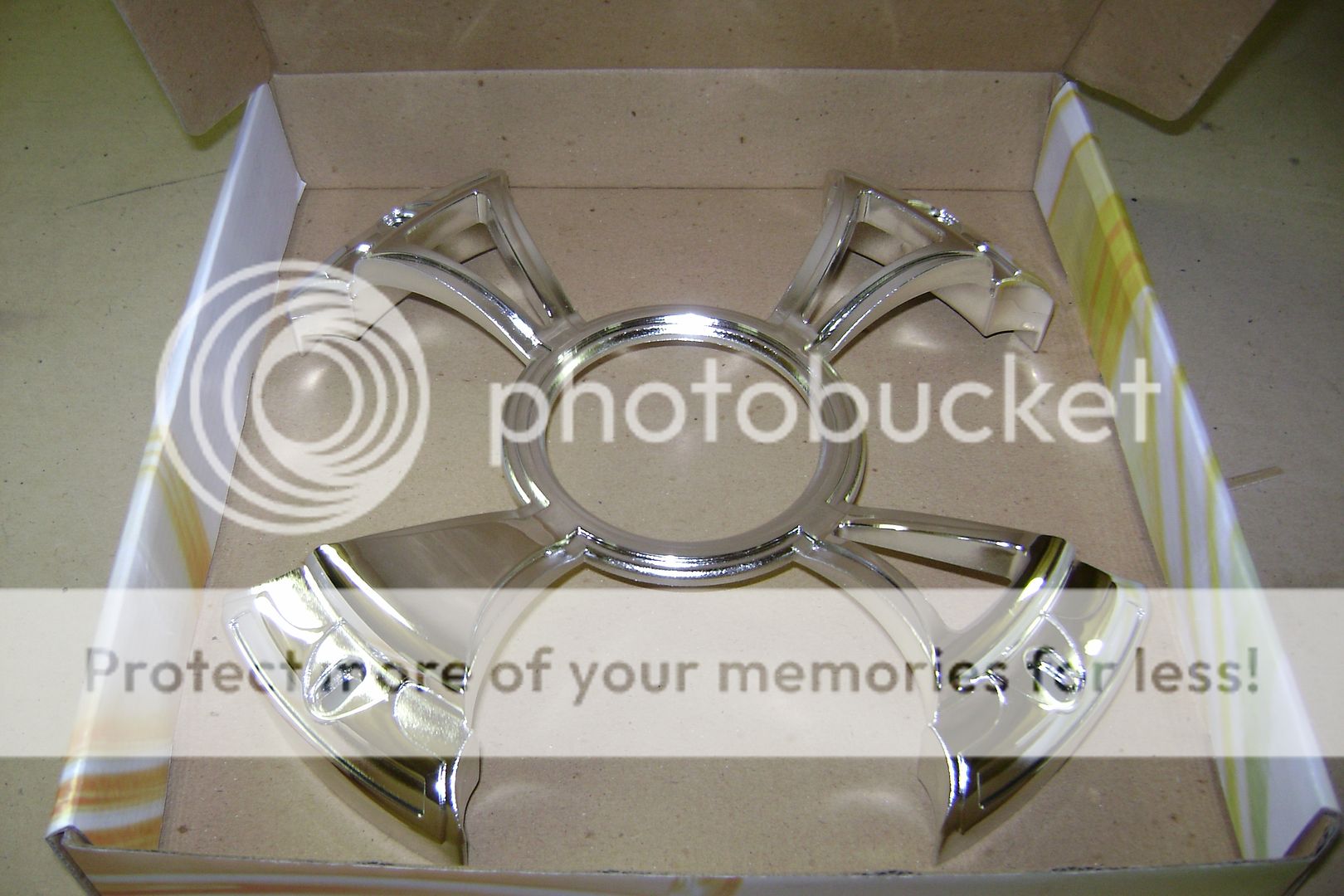
A Fourth kind of option is this sort of thing:
Click the image to open in full size.

Click the image to open in full size.

Click the image to open in full size.

But these are also expensive, ranging from $15 + shipping to $50 (who are they kidding),
and they are almost all outright garish and ugly looking.
Who can stand to look at these? Only Pioneer seems to have any fashion-sense, and it ain't great.
On top of this, they only protect the speaker from the crudest of accidents (large falling objects).


I'm thinking a much better solution is some kind of spaced screening, bake-painted black and trimmed square (maybe bent).
The idea is metal screening to stop puncture or ripping,
and small enough holes to stop pencils and pens, yet not block air-flow.
Also, you should be able to source this stuff by the yard, (i.e., for 12" - 15" speakers per yard)
at a decent price.

And why doesn't any speaker-cover manufacturer take this seriously and offer a decent product?